
Why this matters
When two pages on the same site compete for one search, Google has to guess which to show. It often swaps between them, so neither builds a steady position, and the clicks, links and attention get split in two.
Agencies cause this more than anyone, by accident. A service page goes up, then a blog post on the same subject a few months later, then a landing page for a campaign. Each made sense on its own. Together, they compete.
The business concept: fix the site you've already built
Content cannibalization is a problem you can find and fix without writing anything new, which makes it a strong first job for a new client and a good monthly check for an existing one.
- It explains a stall. A page that should rank but won't is often sharing its search with a sibling.
- It's concrete. "These two pages are splitting 4,520 impressions" is a finding a client understands.
- It protects future content. Once you know which page owns each search, new articles can link to it instead of competing with it.
The SEO concept: one search, one clear answer
Google wants to show the single best page for a search. When a site offers two pages that look equally right, it has to choose, and the choice keeps changing. The usual fixes are:
- Make the winner obvious. Better content on the page that should rank, and more internal links pointing to it with the search in the link text.
- Make each page's job different. If a blog post explains signs of a problem and a service page sells the fix, their titles and headings should say so.
- Merge when they say the same thing. Move the useful parts into the page you keep, then send the other page's address to it with a 301 redirect, so its links and visitors follow.
Not every overlap is a problem. Location pages for different towns, language versions of a page, and a sub-page under its main page are all normal. AlmaSEO leaves those out or labels them as such.
Walkthrough
Where: open a client site from Sites, then SEO Intelligence › Cannibalization. Plans: every plan. Needs: Search Console connected.
- Keep the range at 90 days. Google swaps pages week to week; 90 days shows the conflicts that come and go.
- Start at the top. Searches are sorted by impressions, so the first card has the most traffic at stake.
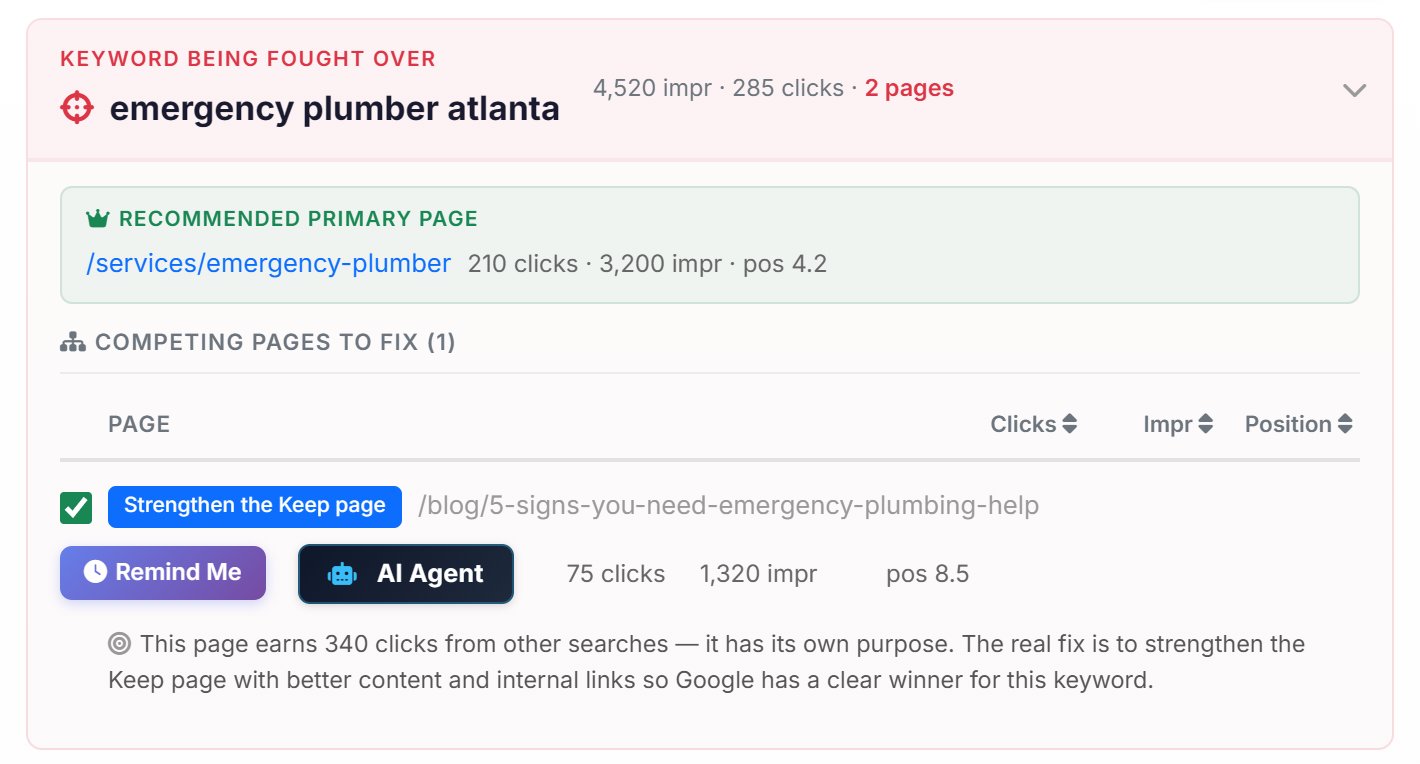
- Open the card. The green box is the page AlmaSEO recommends keeping. Below it are the competing pages.
- Read each label and its reason. It tells you whether to merge, differentiate, link, strengthen the Keep page, or leave it alone.
- Check before you change. Open both pages. Are they really saying the same thing? The label is a starting point, not an order.
- Fix it, tick it, set Remind Me. The tick box marks the page done for the whole team, and Remind Me saves today's numbers for a check in four weeks. On Pro and Agency, AI Agent can take the job instead.
For the fix itself, step by step, see the cannibalization tutorial.
Real-world example: the plumber's emergency page
- The finding: "emergency plumber atlanta" has 4,520 impressions split between the service page (210 clicks, position 4.2) and a blog post, "5 signs you need emergency plumbing help" (75 clicks, position 8.5).
- The Keep page: the service page, because it has the most clicks.
- The label: the blog post gets Strengthen the Keep page. It earns 340 clicks from other searches, so it has its own job and shouldn't be merged.
- The fix: you add a section on response times and prices to the service page, and a link from the blog post to it with "emergency plumber" in the link text.
- Four weeks later: the reminder comes due with the before numbers. If the fix worked, the service page ranks higher and takes a bigger share of the clicks, while the blog post keeps its own traffic.
Key takeaways
- Content cannibalization is two of your own pages competing for one search, so neither ranks as well as one would.
- Not all overlap is a problem: location pages, language versions and sub-pages are normal.
- AlmaSEO keeps the page searchers already prefer, or the one most clearly about the search.
- Most fixes make each page's job clearer. Merge and redirect only when two pages say the same thing.
- Google takes weeks to settle. Check back after about four weeks.
Next up is Traffic Drops: why a client's traffic fell, page by page.