
Why this matters
A ranking report says the client is #3 for "emergency plumber near me". It doesn't say that an AI Overview sits above that result and answers the question first, or that a competitor holds the boxed answer on the search next to it. Those are what decide whether #3 earns any calls.
A SERP analysis looks at the results page itself, the way a customer sees it, and asks: what is Google showing here, and where is the client in it?
The business concept: the page decides the clicks
Two keywords can rank at the same position and earn very different traffic. On one, the top of the page is ten blue links. On the other, it's an AI answer, a map with three competitors, and four questions before the first result.
- Know which kind of page each keyword is. It changes what "good" looks like and what you should promise the client.
- Spend on the pages you can win. A snippet held by a weak page is an opening. A local pack full of businesses with hundreds of reviews is a longer job.
- Show the client the page. "Google answers this one itself, and cites us" is a clearer report than a number.
The SEO concept: SERP features
The SERP is the search engine results page. SERP features are everything on it that isn't a plain result:
- AI Overview: an answer Google writes at the top of the page, with links to the pages it drew from. Being one of those links is visibility even when nobody scrolls.
- Featured snippet: a boxed answer quoted from one page, above the normal results. One site holds it at a time.
- People Also Ask: expandable questions searchers commonly ask about the topic. Each is a ready-made heading for a page.
- Local pack: the map with a few businesses, on searches with local intent.
Which features appear tells you the search intent: questions bring AI Overviews and PAA; "near me" brings the local pack.
Walkthrough
Where: open a client site from Sites, then SEO Intelligence › Live SERP Check. Plans: every plan; each scan spends Data Credits. Needs: Search Console connected, if you want it to pick the keywords.
- Start from the keywords that matter. Press Load my top keywords to fill the box with the site's Search Console searches with the most impressions, or paste your own. Trim the list to the ones you'd act on.
- Choose what to pull. Keep SERP features for the results page. Untick Keyword metrics unless you need volume and cost per click; each half is priced separately.
- Pick the device. For a local business, scan Mobile too; that's where most of its customers search.
- Confirm the cost. AlmaSEO shows the cost, your balance and what's left before anything runs.
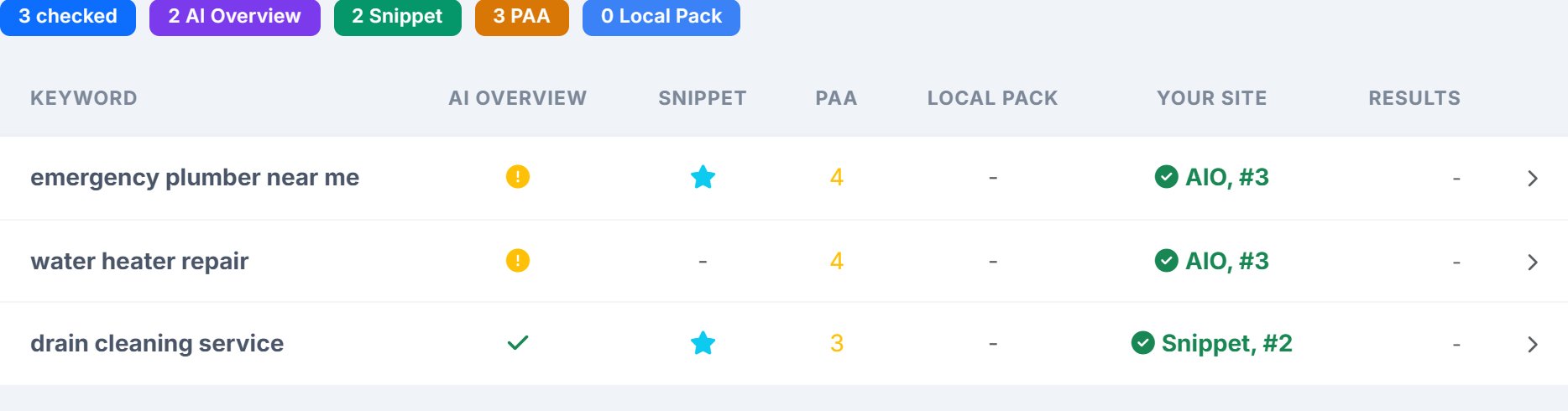
- Read the table. Look first at AI Overview and Your Site together: an AI Overview that doesn't cite the client is the problem to fix.
- Open each keyword. The detail shows who the AI Overview cites, who holds the snippet, the People Also Ask questions and the top ten, with the client marked.
- Track what you'll work on. Track this keyword adds it to Keyword Tracker, so you'll see the ranking move every week.
Real-world example: the emergency plumbing page
- The scan: you scan Rapid Flow Plumbing's three main keywords on desktop.
- What it shows: "emergency plumber near me" has an AI Overview, and Rapid Flow is one of its three sources. A competitor holds the featured snippet with "What qualifies as a plumbing emergency?". Rapid Flow ranks #3.
- The questions: People Also Ask lists "How much does an emergency plumber cost?" and "Do emergency plumbers charge more on weekends?"
- The work: you add a short section to the emergency plumbing page that defines a plumbing emergency in one clear paragraph, then answers both questions with real prices.
- The follow-up: you press Track this keyword, and scan the same keyword again in a few weeks to see whether the snippet has changed hands.
- The report: a screenshot of the results page with the client's citation circled, and one sentence: Google already quotes us here, and next month we go after the snippet.
Key takeaways
- A ranking doesn't tell you what's above it. Look at the whole results page.
- Start from the searches that already bring the client impressions.
- Being cited in an AI Overview is visibility even when nobody scrolls.
- A competitor's snippet and the People Also Ask questions are your content brief.
- Pull only the half you need, and track the keywords you decide to work on.
That's the last lesson in this run. The Academy index has the whole course.