
Why this matters
Most weak SEO content has the same cause: the writer didn't know the business. Generic services, no location, no owner, no proof. Readers can tell, and so can search engines.
The Overview tab is where AlmaSEO shows how well it knows a client before it writes anything for them, and whether the site is connected well enough to publish and measure the work.
The business concept: onboarding is where quality starts
Agencies that collect the right details on day one write better content for the life of the account. The ones that don't spend months patching thin articles.
Treat the first week of a new client as information gathering:
- What they sell, and where they sell it.
- Who they are: the owner, the story, the credentials.
- How to reach them: phone, email, address, hours.
- How they look: logo, slogan, social profiles.
Content Readiness turns that list into a score, so you can see at a glance which clients are ready for content and which aren't.
The SEO concept: search engines understand businesses, not just pages
Search engines try to work out which real business a website belongs to, and connect it with that business's Google Business Profile, its directory listings and its social profiles. Two things help:
- Consistent details. The same business name, address and phone number everywhere (often called NAP: name, address, phone) makes the connection easier.
- Structured data. Schema markup states the business details in a form search engines read directly. AlmaSEO builds it from the same profile Content Readiness scores.
A complete, consistent profile doesn't guarantee rankings. It removes doubt about who the business is, which content and local SEO both rely on.
Walkthrough
Where: open a client site from Sites; Overview is first in its menu. Plans: every plan.
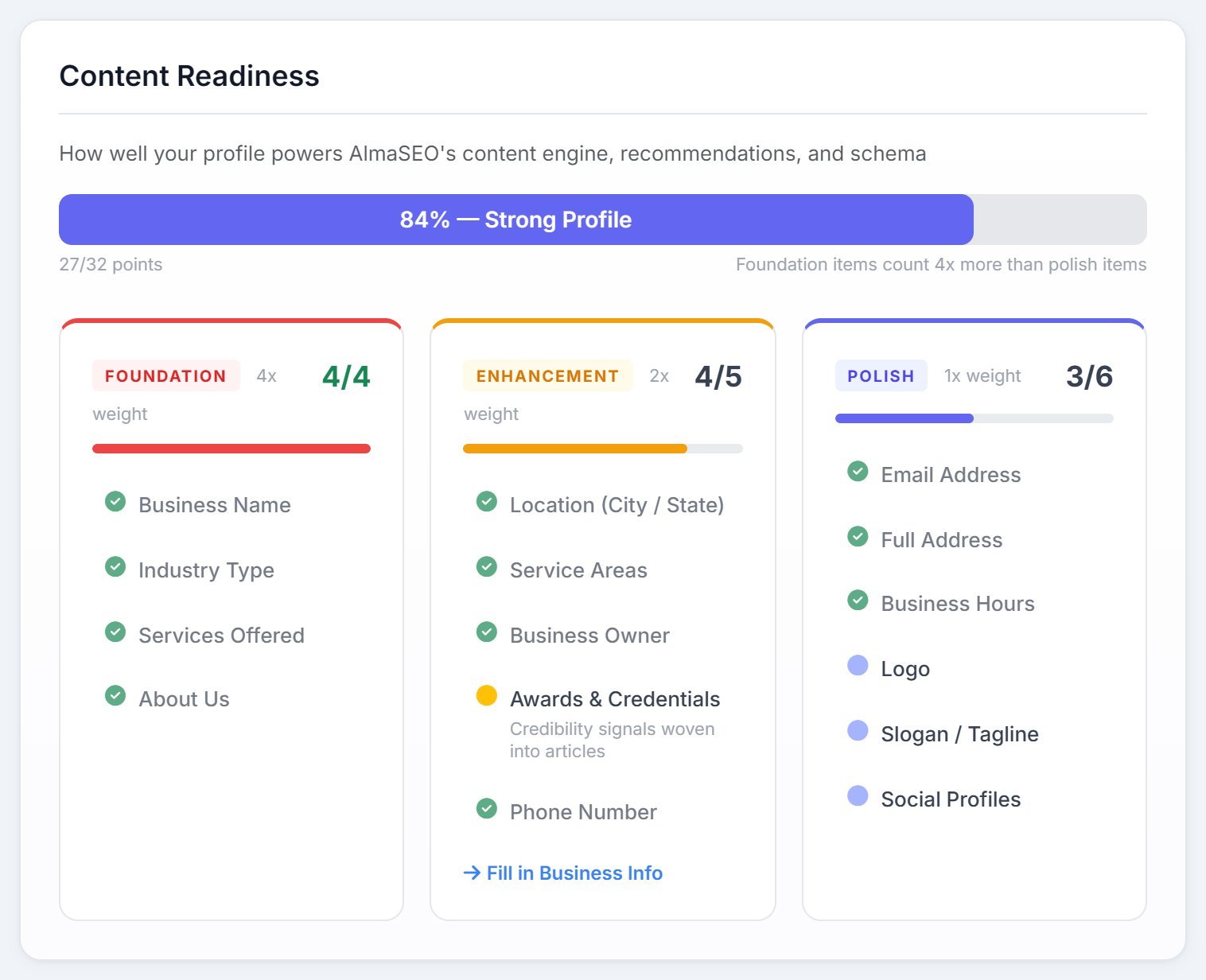
- Read the readiness score. Out of 32 points. Foundation details (business name, industry, services, about us) count four times as much as polish like the slogan.
- Fill the gaps. Each missing item says why it matters. Fill in Business Info takes you to it.
- Check Connections. WordPress, the AlmaSEO plugin, Search Console, Analytics and Business Profile. Anything missing has a link to connect it.
- Glance at the SEO Snapshot. A third-party estimate of the domain's keywords and traffic. It's for context, not reporting; Search Console has the real numbers.
- Set up IndexNow. Generate the key, put the file on the site, verify it. AlmaSEO then tells search engines that use IndexNow when pages change.
Real-world example: the new plumbing client
- Monday: you add Lakeside Plumbing. Overview reads Getting Started: only the business name is filled in.
- The onboarding call: you ask for their services, service areas, the owner's name, licences and hours, and fill them in. Foundation reaches 4/4, and the score jumps to Good Base.
- Connections: Search Console and Business Profile show Not Connected. You connect both while the client is still on the call.
- IndexNow: you generate the key and send the client's developer the file. Next day, Verify Key turns it Verified.
- Week two: you turn on Automation. The first article names their towns, their services and the owner, because AlmaSEO knew them.
Key takeaways
- Better details in, better content out. Fill Foundation first.
- Consistent name, address and phone everywhere help search engines recognise the business.
- Connections don't change the readiness score, but publishing and measuring need them.
- The SEO Snapshot is an estimate; Search Console has the real numbers.
- Viewing a saved snapshot is free; only a live refresh spends Data Credits, and it asks first.
- IndexNow helps search engines that use it find changes sooner. It isn't a ranking boost.
Next up is Quick Wins, the first lesson from SEO Intelligence.