Start your 14-day free trial Every Agency feature switched on. No card required.

Agency Operations

SEO project management for twenty clients, not one website.

SEO project management software built for a book of clients: a recurring work plan for every client, one screen showing which of them is owed work this week, and a planner that tells you when a client has quietly started eating twice the hours you sold them.

Every SEO tool is built for one website. SEO project management starts at thirty.

The tools assume a single site and a single person looking at it. So the moment you have a book of clients, the actual job stops being SEO and becomes remembering: who is owed work this month, which account hasn’t been touched in three weeks, which one is eating hours nobody is billing for, and what exactly you promised to do every Tuesday for the client who signed in March.

That job usually lives in a spreadsheet, a project tool that knows nothing about SEO, and your head. The spreadsheet goes stale, the project tool never gets opened, and your head is the part that burns out.

AlmaSEO keeps the operational layer next to the work. The recurring plan lives on the client’s own profile, the hours you log against it feed the pacing math, and one screen at the top tells you which clients need you this week — built from the work you were already logging, not from a second system you have to maintain.

SEO client management for the solo operator with too many clients — and the agency with a team.

For the solo SEO running a full book

Nobody is going to tell you you’re overloaded.

You’re the whole delivery team. Nothing tells you which of thirty accounts is unprofitable, which one hasn’t been touched in three weeks, or which one is quietly consuming the month. You find out when a client asks — or when they leave.

  • Every client ranked by how far behind it is, most urgent first
  • Clients flagged when nothing’s been logged against them in ten days
  • Where the month lands if you carry on at the pace you’re keeping

For the agency with staff

You need people in the tool without handing over everything.

A contractor should see the two accounts they work on, not your whole client list, and definitely not your margins. Most platforms answer that with a single shared login and a promise that everyone will be careful.

  • Four roles, and per-client access you grant site by site
  • Analysts and viewers see only the sites you explicitly hand them
  • One feed of everything that happened, across the whole book

The SEO project management layer, tool by tool.

Everything here reads from work you already log against clients. None of it costs Data Credits.

The client list

SEO client management software in its plainest form — thirty accounts, and what each one needs, on one screen.

Every client, with its state visible

Activity in the last seven days, whether publishing is running, whether Search Console is connected, when it last published, and how many tasks are overdue — on the card, without opening anything.

Ordered the way you think

Drag the list into your own priority and it stays that way. Filter by type, search, or pull up just the build projects.

Web Vitals watched across the whole book

Every site’s loading performance is compared against its own previous reading, and the ones that got materially worse are counted and flagged. It’s the one health signal AlmaSEO tracks fleet-wide.

Plan Free on every plan.

Powered bySeven-day activityAutomation stateOverdue task countsCustom ordering

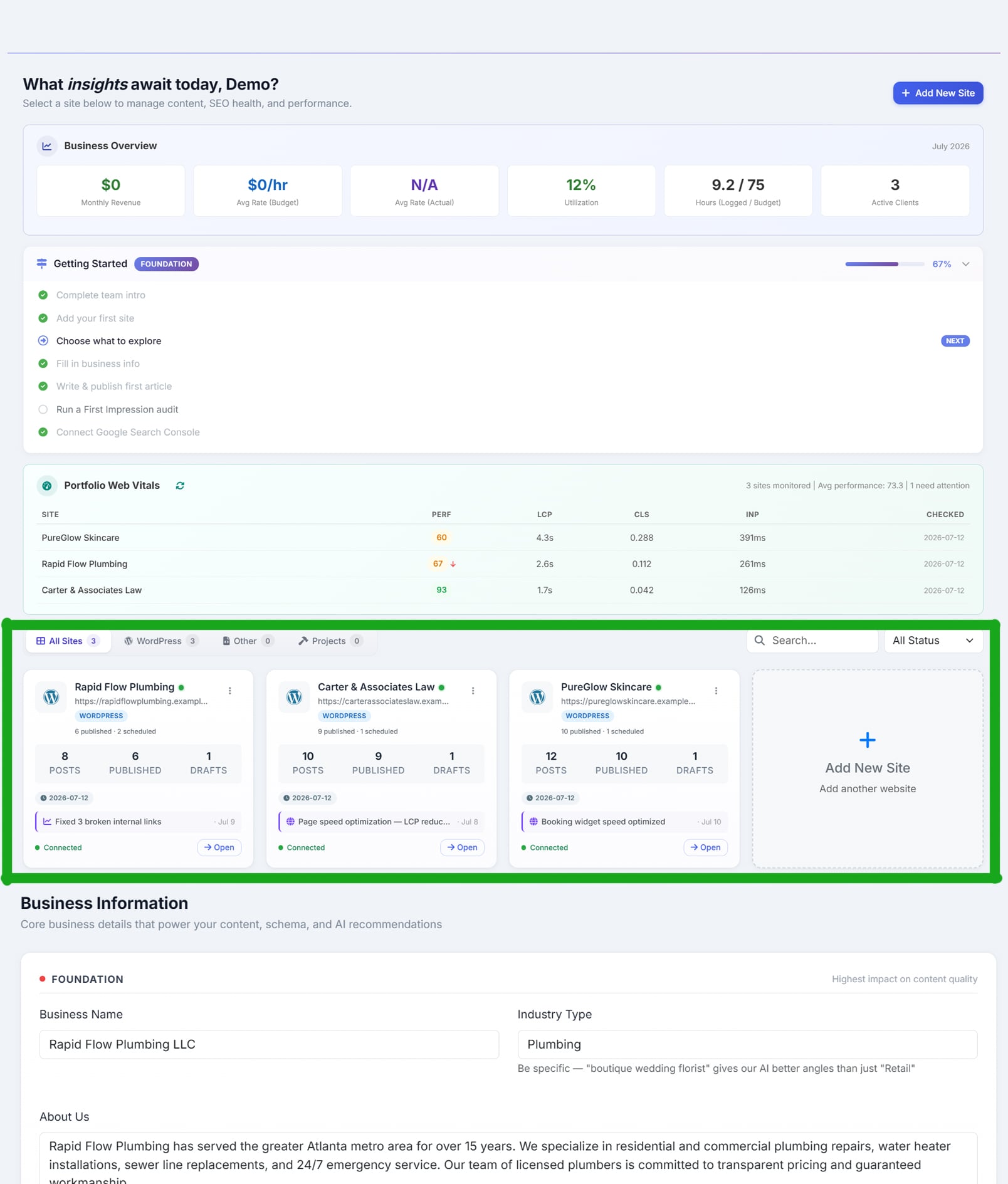
The All Sites dashboard: a Business Overview strip above a Portfolio Web Vitals table headed ‘3 sites monitored, average performance 73.3, 1 need attention’
Every client and what it needs — with the fleet-wide Web Vitals check flagging the one that slipped. The Business Overview strip carries monthly revenue, average budgeted and actual hourly rate, utilization, hours logged against budget, and active client count. Beneath it a Portfolio Web Vitals table lists every client with its performance score, largest contentful paint, layout shift and interaction delay, headed ‘3 sites monitored, average performance 73.3, 1 need attention’ — with a red arrow beside the site that dropped. Below that, a card per client shows published and scheduled post counts, the most recent piece of work with its date, and a connected status.

Strategy Game Plan

The recurring work you promised each client, as a plan that recurs.

Real recurrence, not a repeating to-do

Once, weekly, every other week on the weeks you choose, monthly on the second Tuesday or the 15th. The plan matches how retainers are actually written.

Phases that switch the plan on and off

An onboarding phase and an ongoing phase, where tasks only count as due while their phase is active. A three-month campaign stops nagging you in month four.

Due across every client, in one line

How many strategy tasks are due this week and how many are overdue, across your whole book — each one linking straight to the client it belongs to.

Four playbooks to start from

Local SEO weekly, e-commerce monthly, content-heavy weekly, and backlink building fortnightly. Load one and edit rather than starting at a blank plan.

Plan Pro and up.

Powered byOn-hold toggleReminder daysCompletion criteriaStreaksPhase management

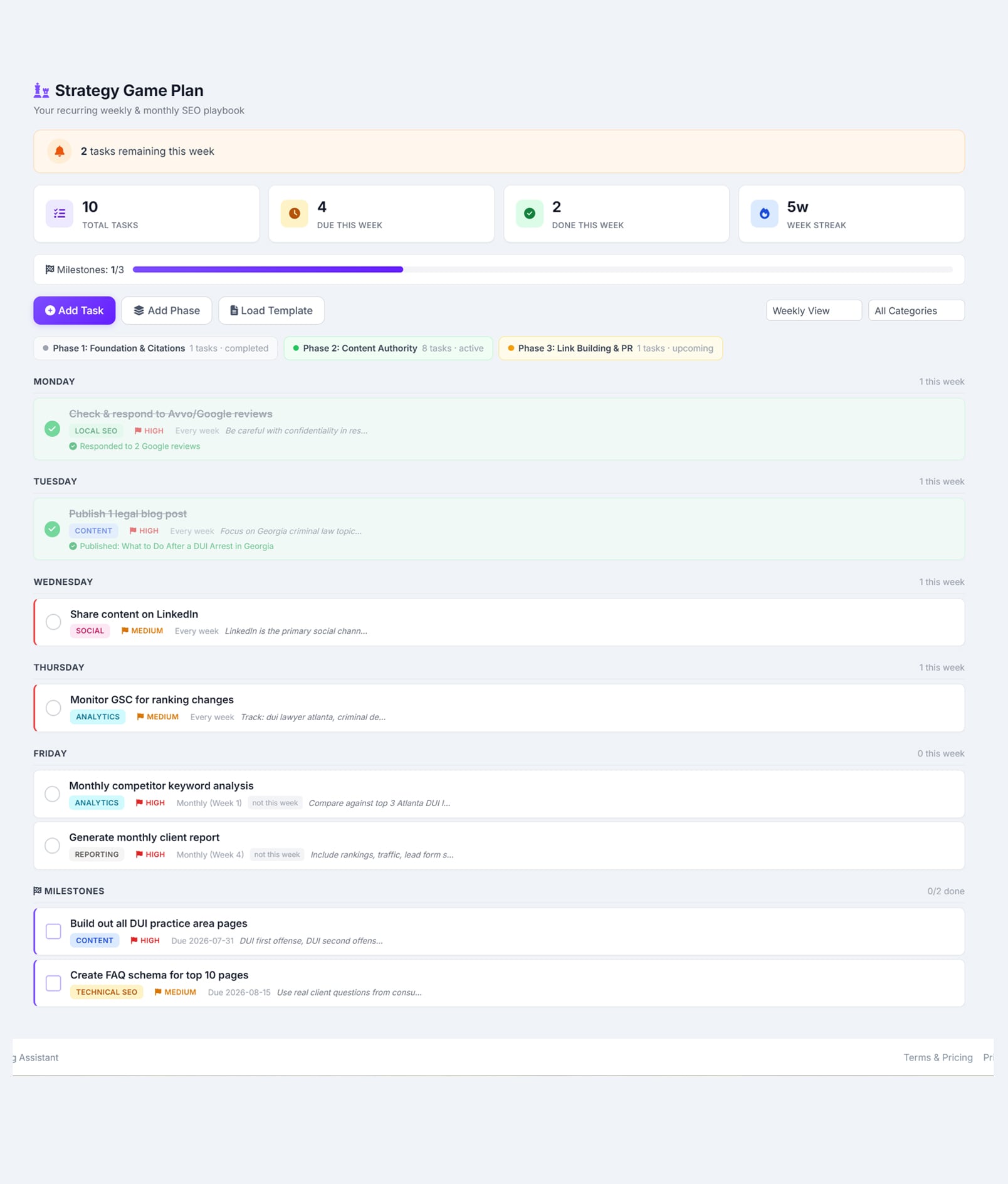
The Strategy Game Plan for a law firm client, with a banner reading 2 tasks remaining this week above the week laid out day by day
One client's recurring playbook — by day, by phase, with what recurs monthly held back until its week. Subtitled ‘Your recurring weekly & monthly SEO playbook’, it opens on a banner reading 2 tasks remaining this week, counters for total tasks, due this week, done this week and a five-week streak, and a milestone progress bar. Three phases are marked completed, active and upcoming. Then the week is laid out by day — a completed review-response task on Monday, a published blog post on Tuesday, a LinkedIn share on Wednesday, a Search Console check on Thursday — each tagged by category, priority and recurrence, with monthly tasks marked ‘not this week’ and two dated milestones listed at the bottom.

Daily Briefing

The screen you see before anything else.

Where you stand, the moment you log in

A once-a-day briefing opens on login — today’s target, hours left, your seven-day pace, and the soonest deadline. You start from where things are, not from a guess.

Your numbers, not the owner’s

Every personal metric — daily target, hours logged today, seven-day average, streaks, compression alerts — is filtered to you. A team member sees their own patterns, never the account owner’s.

The retainer stays a team number

Hours remaining is the whole team’s, because the client’s retainer is a shared obligation. Forty sold, thirty logged by you and five by a teammate — everyone sees the same five left.

Team Performance, at a glance

A contributions panel ranks each member’s last-thirty-day hours — biggest first, you highlighted — with the team total delivered. Who’s carrying the month stops being a guess.

It watches your headspace, too

The same briefing flags weekends worked and heavy-day streaks, so a pattern gets named while there’s still room to change it — then hands you straight to the Workload Planner to act on it.

Plan Pro and up. Team Performance appears once a second member is on the account — and Pro already includes the seats for it.

Powered byOpens once per loginPer-user personal metricsTeam Performance with 2+ membersOne click to the Workload Planner

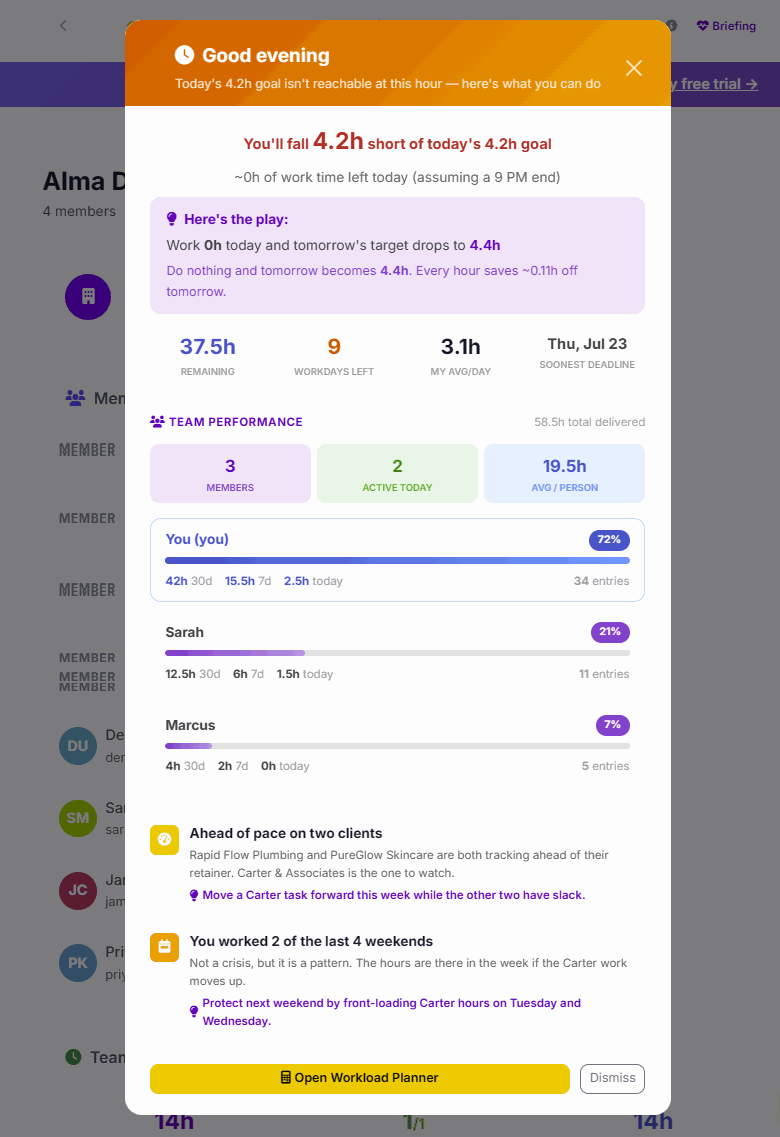
The Daily Briefing that opens on login: a ‘Good evening’ header noting today’s 4.2h goal is out of reach this late and what to do about it; a stat row of 37.5h remaining, 9 workdays left, 3.1h my average per day and the soonest deadline; a Team Performance panel headed 58.5h total delivered with 3 members and 2 active today, and per-member bars — You 72%, Sarah 21%, Marcus 7% — each with hours over 30 days, 7 days and today; then two notes, one that two clients are ahead of pace and which to watch, one that two of the last four weekends were worked; and an Open Workload Planner button
The once-a-day briefing: your pace, the team’s contributions, and a weekend-work pattern named — with the planner one click away.
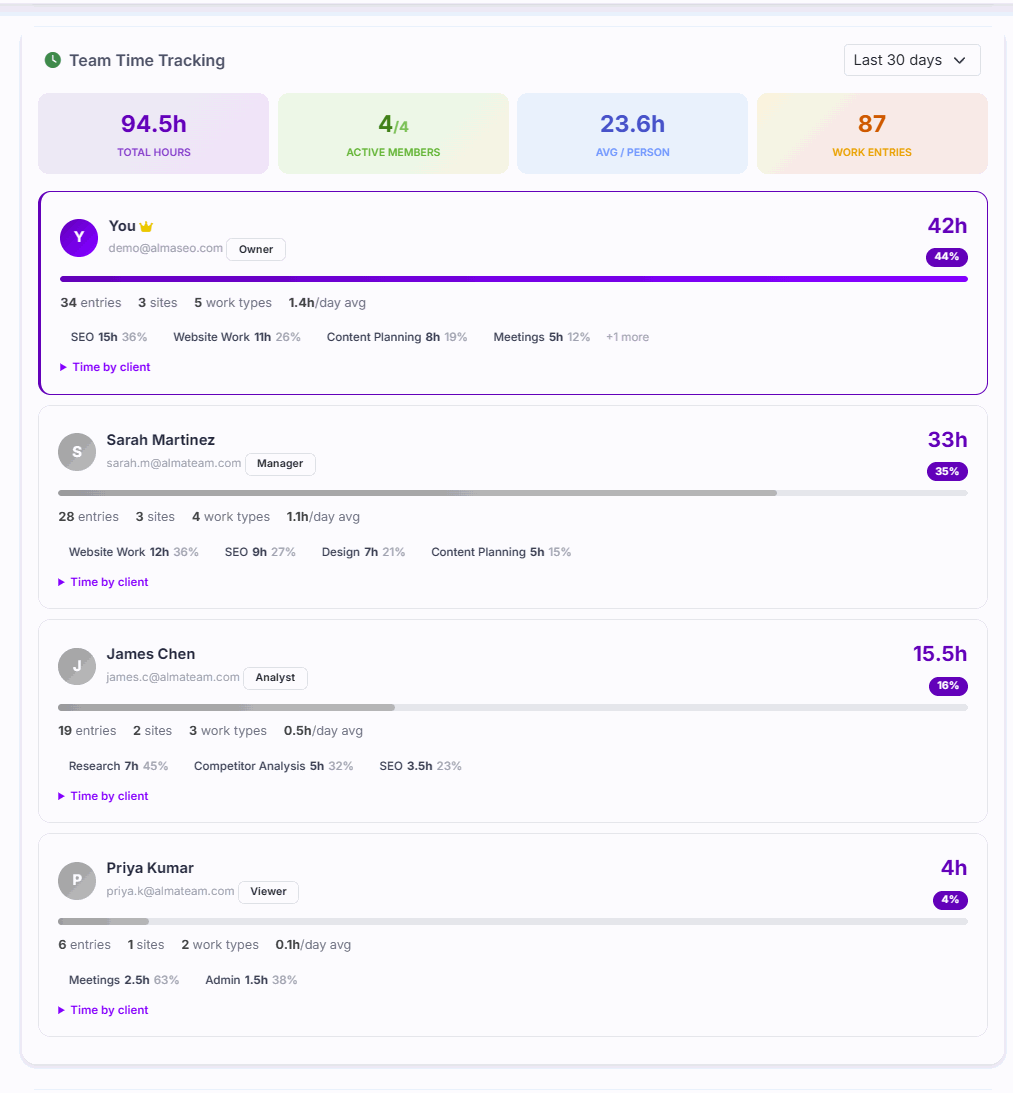
The Team Time Tracking panel over thirty days: 94.5 hours total across 4 of 4 active members, 23.6h average per person and 87 work entries; then a row per member with role and hours — You (Owner) 42h, Sarah Martinez (Manager) 33h, James Chen (Analyst) 15.5h, Priya Kumar (Viewer) 4h — each broken down by work type, with entries, sites and a Time by client toggle.
Team Time Tracking — every member’s hours, role and work-type split across the last thirty days.

Workload Planner

The one that tells you things you would not otherwise find out.

The whole book’s hours, in one total

Every client’s remaining hours added up, turned into a per-day figure across your working week, and projected forward to where the month actually lands at the pace you’ve been keeping. Work Intelligence runs this same arithmetic for one client at a time, and carries the burnout read that goes with it; the planner is the version that spans all of them at once.

Scope creep, named

Any client consuming twice the hours they were allocated gets flagged as scope creep, and the client taking the biggest share of your month gets named. The account quietly swallowing your week stops being invisible.

The clients going quiet

An active retainer with nothing logged against it for ten days is flagged, and it escalates at fourteen and twenty-one. Silence is how retainers get cancelled.

Three versions of the month, to pick from

The daily target offered three ways — weekdays only, weekdays plus Saturdays, or all seven days — so the decision you’re making is which month you’re willing to have, rather than whether the number is bad.

Plan Agency. Needs retainer hours set on at least one client — the whole planner is built on the gap between hours sold and hours logged.

Powered byPer-client daily targetsCycles closing this weekOver-delivered clientsMomentum vs last monthUtilization and real hourly rate

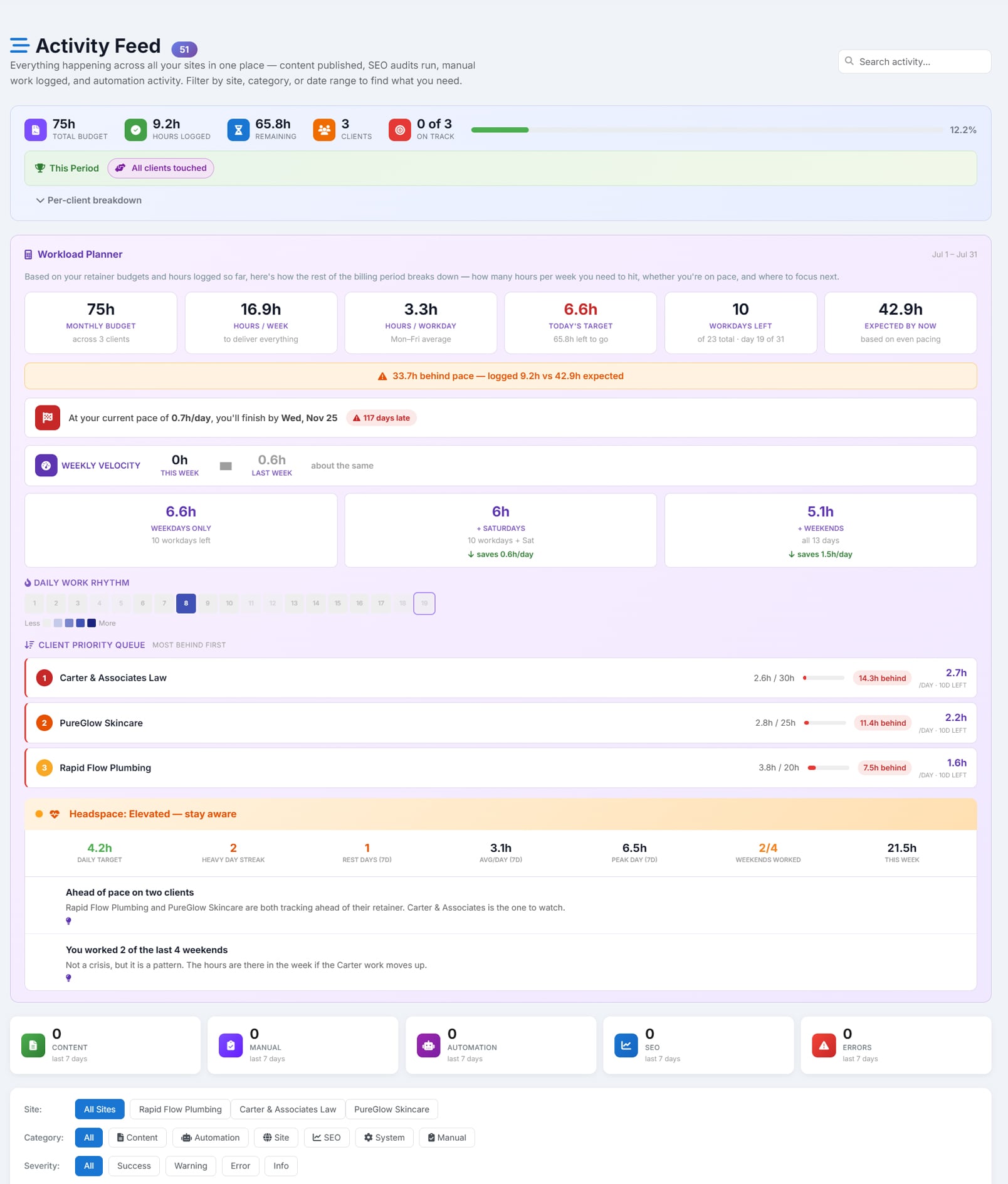
The Workload Planner on the Activity Feed, showing an amber warning that reads 33.7 hours behind pace above a client priority queue sorted most-behind-first
“33.7h behind pace.” Every client ranked most-behind-first, across the whole book at once. A summary strip shows total budget, hours logged, hours remaining, client count and how many are on track. The planner itself carries monthly budget across three clients, hours per week needed, hours per workday, today's target, workdays left and hours expected by now — above an amber warning reading 33.7 hours behind pace, logged 9.2 against 42.9 expected, a projection of the finish date at the current pace, and alternative daily targets for weekdays only, plus Saturdays, or all seven days. The client priority queue names three clients with how far behind each is, and a headspace panel summarises the load the week is carrying.

Activity Feed

Everything that happened, everywhere, in order.

One stream across every client

Published articles, audits, rank checks, logged work, connections — every site you can reach, in one timeline instead of thirty tabs.

Filtered down to the question you have

By client, by category, by severity, by source, by date, or by search. “What happened on this account last month” takes one filter.

Plan Agency.

Powered byPer-site filterSeverity filterDate rangeFull-text search

Team and access

Agency time tracking, and people in the tool without handing over the whole book.

Four roles, with real teeth

Owner, manager, analyst and viewer. Managers can invite, but only analysts and viewers — they can’t mint another manager. An owner can’t walk out without handing the org to someone.

Access granted client by client

Owners and managers see the whole book. Analysts and viewers see only the clients you explicitly grant them — enforced on the data, not hidden in the interface.

Invites that expire

Emailed, and dead after seven days. Seats are checked against your plan when you send one.

Hours by person, not just by client

Every logged entry already records who logged it, so the team page adds them up per person: hours each, which clients they went into, and what kind of work it was. Owners and managers see it; an analyst sees the clients you granted them and not a colleague’s timesheet. People who logged nothing still appear, at zero — that is usually the row you opened it for.

Plan Agency.

Powered byPer-site access matrixPending invitesRole changesSeat limitsHours per memberPer-client split

Website build projects

For the redesigns and builds, not the retainers.

Tasks with one level of subtasks

Statuses, priorities, due dates, and milestones you can filter to on their own. Subtasks collapse under their parent with a done-of-total count.

A timeline you didn’t have to build

Milestones and dated tasks plotted on a horizontal timeline with a marker on today, which turns vertical on a phone.

A 34-point launch checklist, pre-loaded

Pre-launch, DNS and hosting, SEO and analytics, content and QA, post-launch. It seeds itself the first time you open it, so nobody writes the list from memory at midnight.

Plan Free on every plan — on sites you add as a Website Build Project. Retainer clients use the Strategy Game Plan instead.

Powered byMilestone filterProgress barProject notes with pinningClient info readiness

Ownership Tracker

Where the client’s logins and registrar details actually live.

A spreadsheet, behind its own password

Multiple sheets, formatting, undo — locked with a separate password per client and unlocked only for that session. Knowing your AlmaSEO login isn’t enough to open it.

The questions you ask at 2am

Who owns the domain, where the DNS is, whose card renews the hosting. The answers live on the client’s profile instead of in an email from 2023.

Plan Agency.

Powered byMulti-sheetPer-client passwordEmail password resetSession-scoped unlock

What AlmaSEO watches across every client — and what it doesn’t.

Every platform with a client list claims it spots problems across your whole book. Here is exactly where that’s true here, and where it isn’t.

It does watch page speed across every site.

Each site’s performance reading is compared against its own previous reading, and the ones that dropped materially are counted and flagged on your client list. That’s a genuine fleet-wide check, and you don’t have to open a single account to get it.

It does watch your delivery across every client.

Hours, retainers, pacing, silence, scope creep, revenue and margin are all computed across your entire book at once. This is the deep end of the product, and it’s the reason the operations layer exists at all.

It does not claim to find SEO patterns across your clients.

There is no engine here that spots the same ranking drop on six sites and tells you they share a cause. Tools that imply otherwise are usually describing a dashboard that puts numbers side by side and lets you do the noticing. AlmaSEO would rather say plainly where the automation ends.

What SEO client management software costs, and which plan you need.

Nothing in this area spends Data Credits. It’s all built from work you log and clients you add.

Free, on every plan

The client list with its live state, the fleet-wide Web Vitals check, website build projects with their timeline and launch checklist, and Alma, the assistant that can answer “which client have I neglected” out loud.

Pro

The Strategy Game Plan — the recurring work each client is owed, with the phases and recurrence rules that make a retainer run itself, and the weekly roll-up of what’s due across every account — plus the Daily Briefing that greets each member at login with their own pace and the team’s contributions.

Agency

The Workload Planner, the cross-site activity feed it lives on, team roles with per-client access, the Ownership Tracker, and the money view — revenue per client, effective hourly rate, utilization, and which accounts carry the thinnest margins. The planner alone is the reason to be here — nothing else on the market will tell you a client has quietly doubled their hours.

One honest note on the build-project tools: Tasks, Timeline, Notes and the Launch Checklist appear on sites you add as a Website Build Project — they’re for redesigns and new builds. Ongoing retainer clients get the Strategy Game Plan instead, which is built around recurring work rather than a finish line.

SEO project management questions people actually ask.

Can I run recurring work for a book of clients?

Yes, and it is real recurrence rather than a repeating to-do. Once, weekly, every other week on the weeks you choose, monthly on the second Tuesday or on the 15th — the plan matches how retainers are actually written. Onboarding and ongoing phases switch parts of the plan on and off, so tasks only count as due while their phase is active and a three-month campaign stops nagging you once it ends.

Do I have to build every client plan from scratch?

No. Four playbooks come ready to load and edit: local SEO weekly, e-commerce monthly, content-heavy weekly, and backlink building fortnightly.

What do I see when I log in?

A once-a-day briefing with today’s target, the hours left, your seven-day pace and the soonest deadline, so you start from where things actually are. Alongside it the client list shows each account’s state — activity in the last seven days, whether publishing is running, whether Search Console is connected, when it last published and how many tasks are open — and you can drag the list into your own priority and it stays that way.

Can I control which clients a team member sees?

Yes, client by client. There are four roles — owner, manager, analyst and viewer. Owners and managers see the whole book; analysts and viewers see only the clients you explicitly grant them, and that is enforced on the data rather than hidden in the interface. Managers can invite, but only analysts and viewers — they can’t mint another manager. Invites are emailed and die after seven days, and seats are checked against your plan when you send one.

Are personal metrics private from the rest of the team?

Your own numbers are yours — daily target, hours logged today, seven-day average, streaks and compression alerts are all filtered to you, so a team member sees their own figures rather than the owner’s. The exception is deliberate: hours remaining on a retainer is a team number, because the client’s retainer is a shared obligation. Team Performance ranks each member’s last-thirty-day hours with the team total delivered.

Will it tell me when a client is going wrong?

It names two failure modes directly. Any client consuming twice the hours they were allocated is flagged as scope creep, and the client taking the biggest share of your month gets named. Separately, an active retainer with nothing logged against it for ten days is flagged, escalating at fourteen and twenty-one days — silence is how retainers get cancelled.

Can I see everything that happened on one account?

Yes — published articles, audits, rank checks, logged work and connections across every site you can reach, in one timeline instead of thirty tabs. Filter by client, category, severity, source, date or search, so “what happened on this account last month” takes one filter.

Are tasks and timelines available for every client?

Not for every client, and this is worth being straight about. Tasks, Timeline, Notes and the 34-point launch checklist appear on sites you add as a Website Build Project — they are built for redesigns and new builds. Ongoing retainer clients get the Strategy Game Plan instead, which is built around recurring work rather than a finish line. Both kinds of client also get the encrypted per-client spreadsheet and the profile holding the answers you need at 2am: who owns the domain, where the DNS is, whose card renews the hosting.

See SEO project management across a real book of clients.

Open a client’s work plan in the demo, then look at the client list behind it — the same data the pacing math reads.